
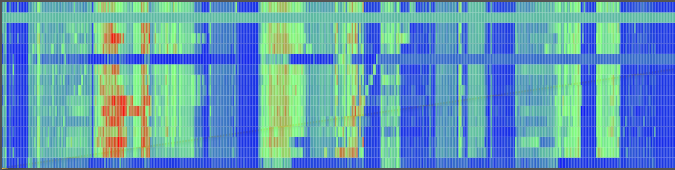
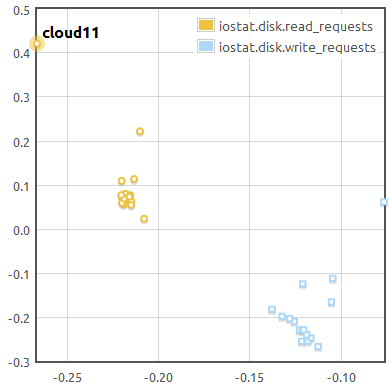
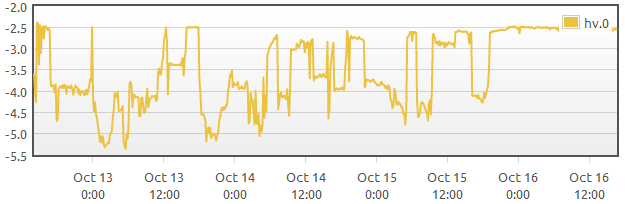
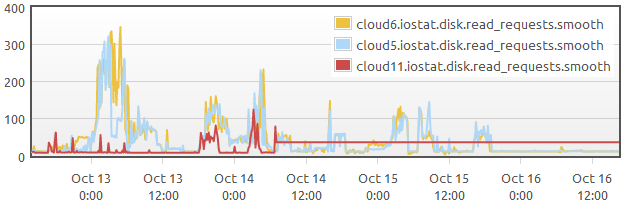
Timeseries data are prevalent in large-scale computing centers. Systems often capture sampled metrics of performance, utilization, and even sensor data like temperature. These streams are used for monitoring, placement, optimization, and more.
RainMon is a framework to manage massive data-center timeseries streams that are lengthy and bursty in nature. It uses a multi-stage modeling approach. In the first phase, the incoming data streams are decomposed into "smooth" and "spiky" components. In the second phase, the streams are summarized into a set that can be visualized and understood. In the third phase, predictions are made about the future state of the system. Such a framework provides the potential to address a number of practical advances for data center efficiency:
- Detecting potential anomalies or alert conditions. Dramatic changes in model parameters can be predictors of problems or abnormalities.
- Reduce the storage requirement of streams through compression. By storing only the model parameters and occasional original data points, potentially large timeseries data can be effectively summarized.
- Improve alerting and placement algorithms by predicting future usage. Even a short-term view of future usage can be valuable for decision-making. By playing the model forward, we can obtain this data.
The framework incorporates several existing algorithms from the literature including Cypress1, SPIRIT2 and Kalman filters3. RainMon has been applied to large data streams collected from production clusters to detect real anomalies.
Click here for a demo
The demonstration provided above is an example of the output of RainMon after an analysis has been run.
RainMon is hosted on github. The tool is open-source and available under a BSD license. Additionally, we are providing the CMU.net dataset described in the KDD 2012 paper to the community (see the data directory). See the guide for additional information.
 |
Download RainMon |
A copy of the users' guide is located here. For the most up-to-date version, clone the repository and look in the doc directory.
- Yoshihisa Abe
- Vishnu Boddeti
- Kai Ren
- Ilari Shafer
- Lennart Liberg